Third Shot Tuesday: Kitchen Line Mastery (How to Win the Dinking War) [2026]
THIRDSHOTFINDS.COM and The Deal Dinker are reader-supported. When you buy through links on our site, we may earn an affiliate commission at no extra cost to you.
Pickleball at every level above beginner is decided at the kitchen line. The serve and return set the stage, the third shot gets you there, but the dink rally is where the point is genuinely won or lost.
A dink rally is really a contest of two questions: who breaks first, and who forces the break. If you only wait for your opponent to make a mistake, your game will plateau. To climb the ranks, you need to actively move your opponents and set up the error.
Welcome back to the kitchen line for another Third Shot Tuesday. The Deal Dinker here. Today, we are breaking down the exact mechanics, positioning, and strategies required for total kitchen line mastery.
1. The Foundation: Form and Soft Hands
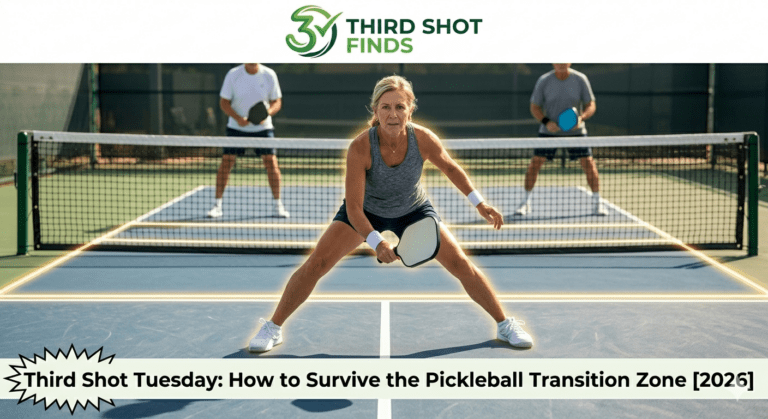
A dink is not a swing; it is a lift or a push into the pickleball kitchen. Before you worry about angles and spin, you must master the physical fundamentals of a consistent dink shot.
- The Stance: Start with your knees bent, feet slightly wider than shoulder-width apart, and your weight balanced on the balls of your feet. Keep your paddle up in front of your body so you can react quickly.
- Soft Hands: Your grip should stay relaxed, not tight. A looser grip helps absorb the ball and prevents pop-ups, which is one of the most common mistakes players make. Players working toward the 5.0 skill level will tell you that soft hands are the single biggest separator between good and elite kitchen play.
- Short Swing Path: A dink does not need a big stroke. Use a short, compact motion with minimal backswing and a calm follow-through. Big swings create big errors.
- Footwork First: Take small adjustment steps to get behind the ball before contact. Do not lunge unless you absolutely have to. When dinking, you should always be taking a step into your shot rather than having stagnant feet.
2. Shot Selection: Where to Aim
Once your mechanics are dialed in, you need to know where to put the ball. Not all dinks are created equal.
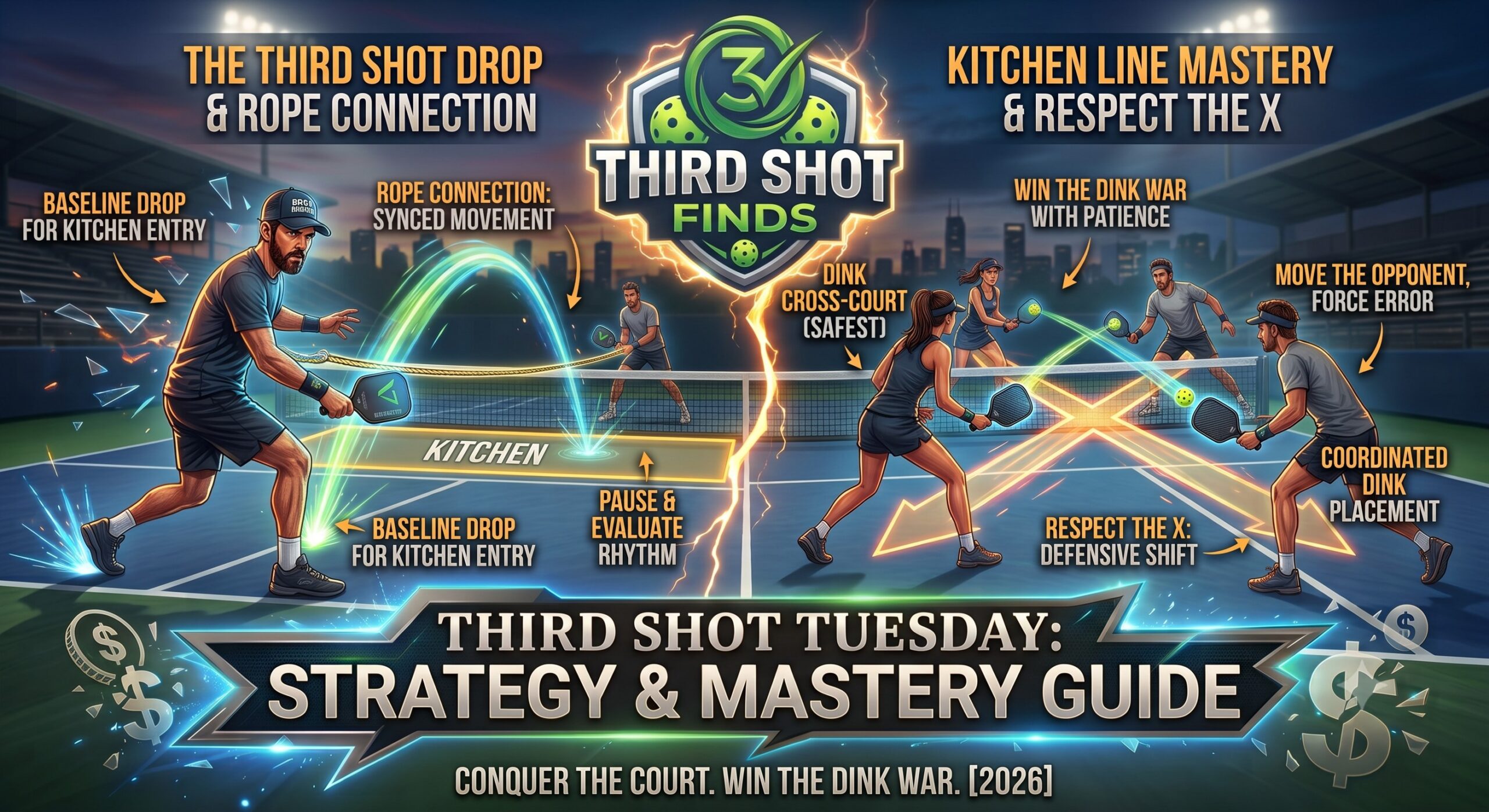
- The Cross-Court Dink: This should be your default and safest option. The cross-court dink travels over the lowest part of the net, gives you the most court to land in, and provides the widest margin for error.
- The Straight-Ahead (Down-the-Line) Dink: This shot is riskier because it crosses a higher part of the net and has less court to land in. However, it is your main weapon for moving opponents. Used deliberately, it pulls a player toward the sideline and opens up the middle of the court for your next ball.
- The Dead Dink: This is a ball that has little spin or pace, landing shallow in the kitchen without bouncing very high. It is an excellent defensive tool against highly aggressive opponents because it gives them nothing to speed up.
3. The “Respect the X” Strategy
If you are playing with a new partner, communication at the kitchen line can get messy, especially when a ball is hit down the middle.
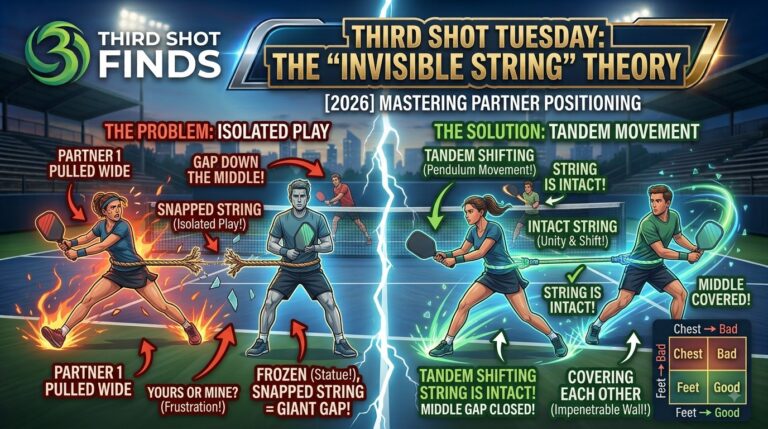
To solve this, use a dinking strategy called “Respect the X”. Imagine a big X covering the court. You and your partner should take the balls that are traveling diagonally towards you. It will be much easier for you to receive a ball coming towards you than for your partner to try and handle a ball moving away from them. By respecting the X, you instantly know whose ball is what.
4. Moving as a Unit
A dink is only as good as where you are standing when you hit it. Dinking from two feet behind the line is a losing proposition because your soft shots will land shorter and sit up higher for the opponent to attack.
In doubles, you and your partner should slide left and right together, as if there is a rope tied between you. When a cross-court dink pulls your partner out wide, you must shift over to cover the middle. The gap that loses points is the one created between two players who move independently.
The Tape of the Tape: Dink Types
| Shot Type | Risk Level | Best Used For… |
| Cross-Court Dink | Low | Establishing consistency and resetting the rally. |
| Down-the-Line Dink | High | Pulling the opponent wide and opening the middle. |
| Dead Dink | Low | Neutralizing fast-paced, aggressive bangers. |
| Backhand Slice Dink | Medium | Acting as your foundational shot to put the ball in play. |
The Deal Dinker’s Final Take
You will never graduate out of intermediate play until you learn to love the dink. Stop trying to blast every ball through your opponents. Keep your paddle up, soften your grip pressure, and focus on moving your feet. A player with a patient, purposeful pickleball dinking strategy will beat a harder hitter more often than not, because patience and placement force the error that power alone cannot.
Ready to upgrade your soft game? If you are consistently popping the ball up, your thin power paddle might be working against you. Switch to a thicker, 16mm control paddle to increase your dwell time. Click here to check out our review of the best control paddles under $100!
Frequently Asked Questions: Kitchen Line Mastery
When should I speed up a dink?
Three clear signals tell you it is time to attack:
The ball sits up above net height where you can hit down on it.
Your opponent is stretched wide or off balance.
You have successfully moved them out of the middle, creating a large gap.
What is the most important dink shot to learn first?
The backhand slice dink should be your default shot when you are at the kitchen. It is a passive shot that extends the rally and gives you the ability to lean in and potentially attack the next ball out of the air.
How do I practice my dinking?
Improvement comes from realistic constraints. Run a “Cross-court only” drill where both players dink diagonally continuously, focusing solely on control and stringing together a high number of consecutive shots.