Third Shot Tuesday: The “Invisible String” (Mastering Partner Positioning) [2026]
THIRDSHOTFINDS.COM and The Deal Dinker are reader-supported. When you buy through links on our site, we may earn an affiliate commission at no extra cost to you.
It is the most frustrating shot in doubles pickleball: your opponents hit a slow, bouncing ball right down the center line. You look at your partner, your partner looks at you, and the ball bounces untouched for a clean winner. “Yours?” “Mine?” It doesn’t matter. You both just lost the point.
The root cause of this error is rarely a lack of skill; it is a fundamental misunderstanding of court coverage. In intermediate play, partners tend to act like statues rooted to the center of their respective boxes. But the court is dynamic.
Welcome back to the kitchen line for another true Third Shot Tuesday. The Deal Dinker here. Today, we are curing the “down the middle” syndrome by mastering the Invisible String Theory.
1. The Invisible String Concept
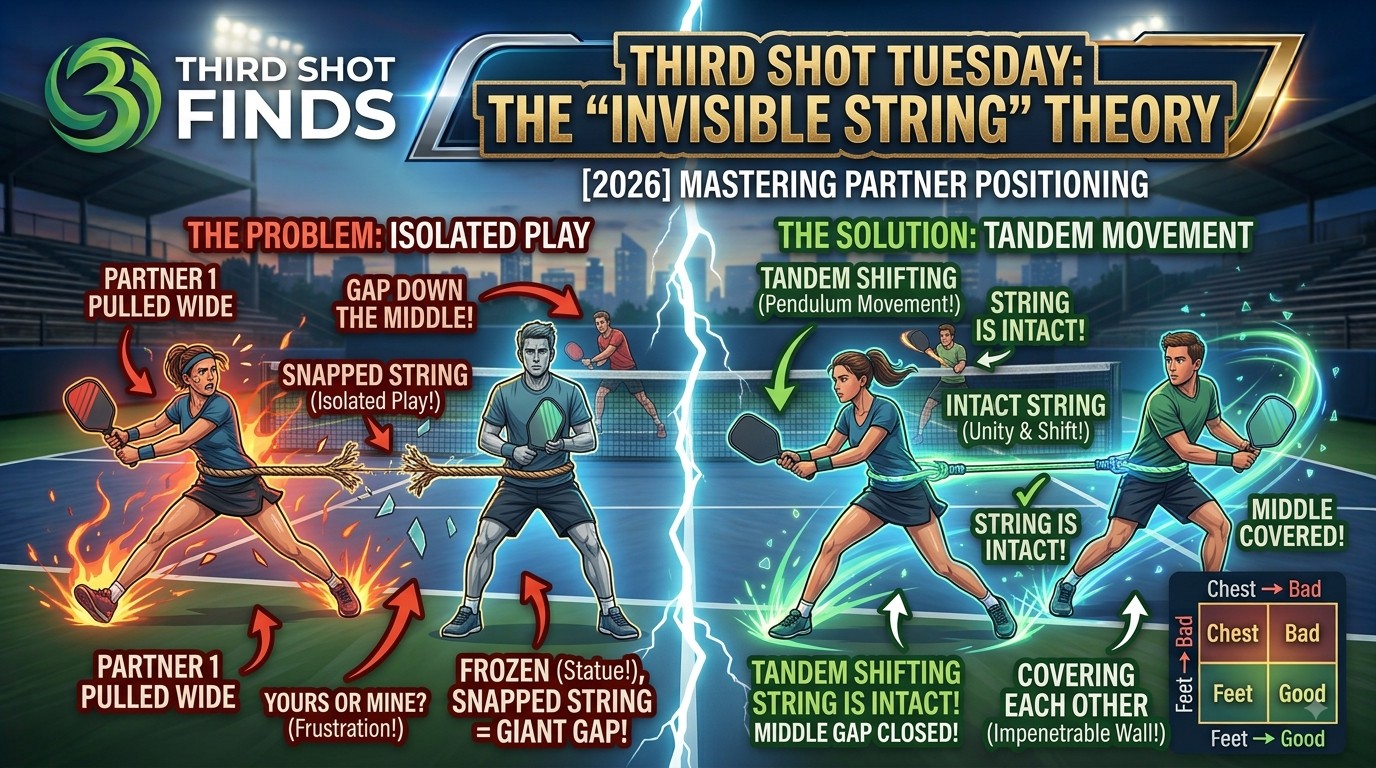
Imagine a heavy-duty, 8-foot-long bungee cord connecting your waist to your partner’s waist.
- If your partner gets pulled wide to the left sideline to dig out an angled dink, what happens to the string? It pulls you to the left as well.
- If you do not move with them, the string snaps. In pickleball, a “snapped string” represents a massive, gaping hole right down the middle of your court.
The golden rule of doubles positioning is that you must shift together like a pendulum swinging on a single hinge. If the ball goes out wide, the partner on that side steps toward the sideline to cover the line, and the other partner must slide over to the center line to protect the middle. Yes, this temporarily leaves the far opposite sideline open, but cross-court speed-ups are incredibly difficult to execute and give you plenty of time to react. The middle is the danger zone. Protect the string.
2. Shading the Ball
Your team’s position should always be dictated by where the ball is on the opponent’s side of the net. This is called “shading.”
- When the ball is directly in front of you (Straight Ahead): You should be positioned squarely in front of the ball to defend the direct drive. Your partner should be cheating slightly toward the middle line.
- When the ball is cross-court from you: Your partner (who is directly in front of the ball) steps up to cover their sideline and the direct drive. You must slide to the center line (the “T”) to cover the middle.
If you watch professional players, they are constantly shuffling side-to-side in tandem, completely dictated by the lateral movement of the ball.
3. The Forehand Takes the Middle Rule
Even with perfect shading and an intact invisible string, balls will still land directly between you. To eliminate the deadly hesitation of “Yours or mine?”, you must establish a default rule before the match even begins.
In 95% of standard recreational and competitive matchups, the player with their forehand in the middle takes the middle ball. Why? Because the forehand naturally provides more reach, a stronger strike zone, and better anatomical mechanics to hit an aggressive shot. If you are playing on the right side (as a right-handed player), your backhand is in the middle. Your default mindset must be to let your partner (who has their forehand in the middle) take those center shots, while you focus on covering your sideline and the right-side gaps.
The Tape of the Tape: The Positioning Matrix
| If the Opponent hits the ball… | Partner 1 (Targeted) Should… | Partner 2 (Off-Ball) Should… |
| Wide to the Left Sideline | Shift left to cover the line. | Shift left to cover the center line. |
| Right Down the Middle | Forehand steps in and takes it. | Backhand yields and covers the wide gap. |
| Deep to the Baseline | Drop back to absorb the pace. | Drop back with them. (Never split horizontally). |
The Deal Dinker’s Final Take
Playing successful doubles is not about having two great singles players on the same side of the net. It is about creating an impenetrable, unified wall.
The next time you step onto the court, picture that 8-foot string connecting you to your partner. Stop standing frozen in the middle of your box. When they shift left, you shift left. When they shift right, you shift right. By closing the gap and establishing the “forehand takes the middle” rule, you will eliminate those frustrating miscommunications and force your opponents to try and beat you with low-percentage, low-margin shots.