Third Shot Tuesday: Pickleball Shoes vs. Running Shoes (Save Your Ankles) [2026]
THIRDSHOTFINDS.COM and The Deal Dinker are reader-supported. When you buy through links on our site, we may earn an affiliate commission at no extra cost to you.
You have the perfect raw carbon-fiber paddle. You mastered the cross-court dink. You show up to the local courts ready to dominate, wearing your favorite, ultra-cushioned running shoes. They feel like walking on clouds.
Three games in, your opponent hits a sharp angle. You sprint laterally to chase it down, your foot plants, but the thick, squishy sole of your running shoe rolls outward. Pop. Your ankle gives out, and you are sitting on the asphalt reaching for an ice pack.
The most dangerous piece of gear on a pickleball court isn’t a hot paddle—it is the wrong footwear. Welcome back to the kitchen line. The Deal Dinker here. Today, we are breaking down the critical structural differences in pickleball shoes vs. running shoes so you can protect your joints and move like a pro.
1. The Anatomy of a Mismatch
Running shoes are marvels of engineering, but they are built for exactly one direction: forward. They feature thick, heavily cushioned midsoles designed to absorb vertical impact over miles of straight-line pavement.
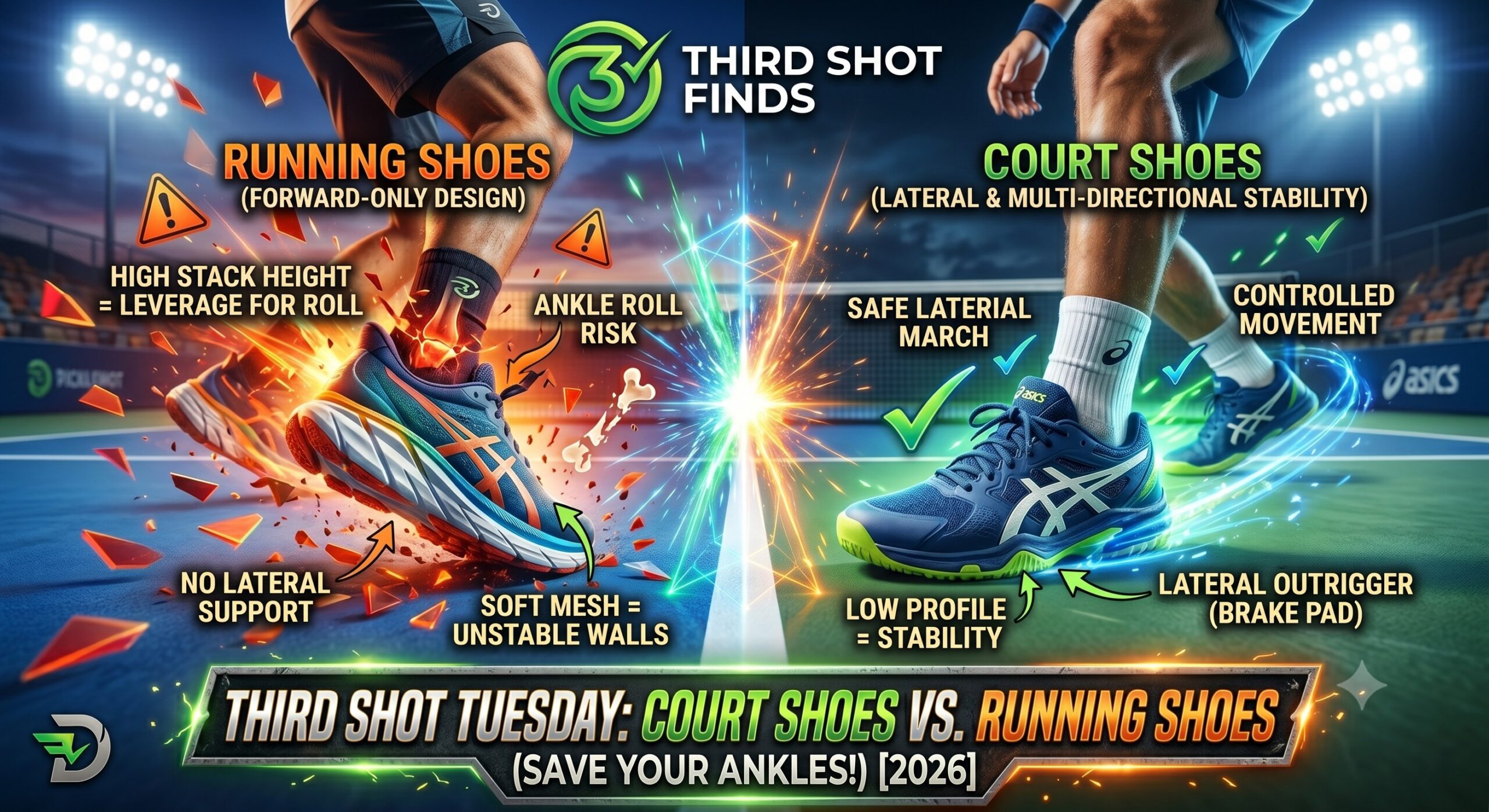
Pickleball, on the other hand, is a game of sudden stops, heavy lateral shuffling, and instantaneous changes of direction. When you try to change direction quickly in a running shoe, the high stack height and soft mesh walls offer zero lateral support. Your foot keeps moving sideways while the sole stays stuck to the court, resulting in a rolled ankle or a blown knee.
2. What Makes a True Court Shoe Different?
A purpose-built pickleball shoe (or a hardcourt tennis shoe) is constructed completely differently to handle the intense physics of court sports.
- Low Profile Stack Height: Court shoes sit much lower to the ground. Bringing your center of gravity down drastically reduces the leverage required to roll your ankle.
- Lateral Outrigger Guards: Look closely at the outer edge of a court shoe. You will find a stiff, reinforced piece of rubber or plastic extending outward. This acts as a literal brake pad, stabilizing your foot during aggressive lateral cuts.
- Heavy-Duty Rubber Outsoles: Running shoes use soft, exposed foam to save weight. Hardcourt surfaces will chew through that foam in weeks. Court shoes feature durable, dense rubber wraps that prevent toe-drag wear and offer maximum traction without slipping.
The Tape of the Tape: Running vs. Court Shoes
| Feature | Running Shoes | Pickleball/Court Shoes |
| Primary Motion | Linear (Forward) | Multi-directional (Lateral & Diagonal) |
| Sole Thickness | Thick, high stack height | Low-profile, dense compound |
| Edge Support | Soft mesh walls (No support) | Stiff chassis & lateral outriggers |
| Outsole Material | Soft foam & minimal rubber | Thick, high-abrasion rubber |
| Injury Risk | High risk of rolled ankles | Maximizes joint stabilization |
3. The Deal Dinker’s Top Picks on Amazon
If you are ready to retire your running shoes before they retire your knees, you do not need to spend a fortune. Here are the top-performing, highly durable picks available right now:
- The Value Champion: Asics Gel-Dedicate 8 Asics makes some of the finest court footwear on the planet. The Gel-Dedicate line provides incredible lateral stability, a highly durable wrap-around toe guard, and signature gel cushioning in the forefoot to absorb impact without sacrificing court feel.
- The Wide-Foot Savior: K-Swiss Express Light Pickleball If court shoes usually feel too narrow or stiff for you, K-Swiss is the answer. They specifically engineer their shoes with a wider toe box and lightweight materials, meaning they require zero “break-in” time before hitting the court.
➡️ Click Here to view the Asics Gel-Dedicate 8 Court Shoes on Amazon
➡️ Click Here to view the K-Swiss Express Light Pickleball Shoes on Amazon
The Deal Dinker’s Final Take
Think of your footwear as the tires on a sports car. You wouldn’t put off-road mud tires on a Porsche, and you shouldn’t wear straight-line running shoes on a high-speed lateral pickleball court. Investing in a dedicated pair of court shoes isn’t just about playing better—it’s about ensuring you can walk off the court on your own two feet.
Frequently Asked Questions: Court Footwear
Can I use indoor volleyball or basketball shoes for outdoor pickleball?
You can use them indoors, but do not wear them on outdoor concrete. Volleyball and basketball shoes use soft, sticky gum-rubber outsoles designed to grip indoor hardwood floors. If you take them onto a rough asphalt outdoor court, the abrasive surface will grind the tread flat in less than a month.
How tightly should I lace my pickleball shoes?
Significantly tighter than your casual walking shoes. Your heel should be locked firmly into the back of the shoe with absolutely zero slippage when you lung forward. If your foot slides around inside the shoe, you will develop nasty blisters and black toenails from your toes constantly smashing against the front wall.
How often should I replace my pickleball shoes?
If you play 2 to 3 times a week, a high-quality pair of court shoes will last roughly 4 to 6 months. Look at the tread underneath the ball of your foot. If the grooves are worn smooth or you notice you are starting to slide around during sudden stops, the rubber has degraded and it is time for a fresh pair.