Indoor vs. Outdoor Pickleball Balls: Which Do You Actually Need? [2026]
THIRDSHOTFINDS.COM and The Deal Dinker are reader-supported. When you buy through links on our site, we may earn an affiliate commission at no extra cost to you.
You just bought your first paddle, you showed up to the local park, and you pull a bright green ball out of your bag. The grizzled veteran in the lawn chair next to the court shakes his head. “You can’t use that out here,” he says. “That’s an indoor ball.”
You look at the ball. It’s round. It has holes in it. It bounces. What is the big deal?
Believe it or not, using the wrong pickleball in the wrong environment will completely ruin your game. The wind will toss it around like a paper bag, or it will skid wildly out of bounds. Welcome back to the kitchen line. The Deal Dinker here. Today, we are settling the score on indoor vs. outdoor pickleball balls so you never show up with the wrong gear again.
1. Outdoor Pickleballs: The Heavy Hitters
Outdoor pickleball is a battle against the elements—specifically, the wind and rough concrete surfaces. Because of this, outdoor balls are engineered to be heavy, fast, and durable.
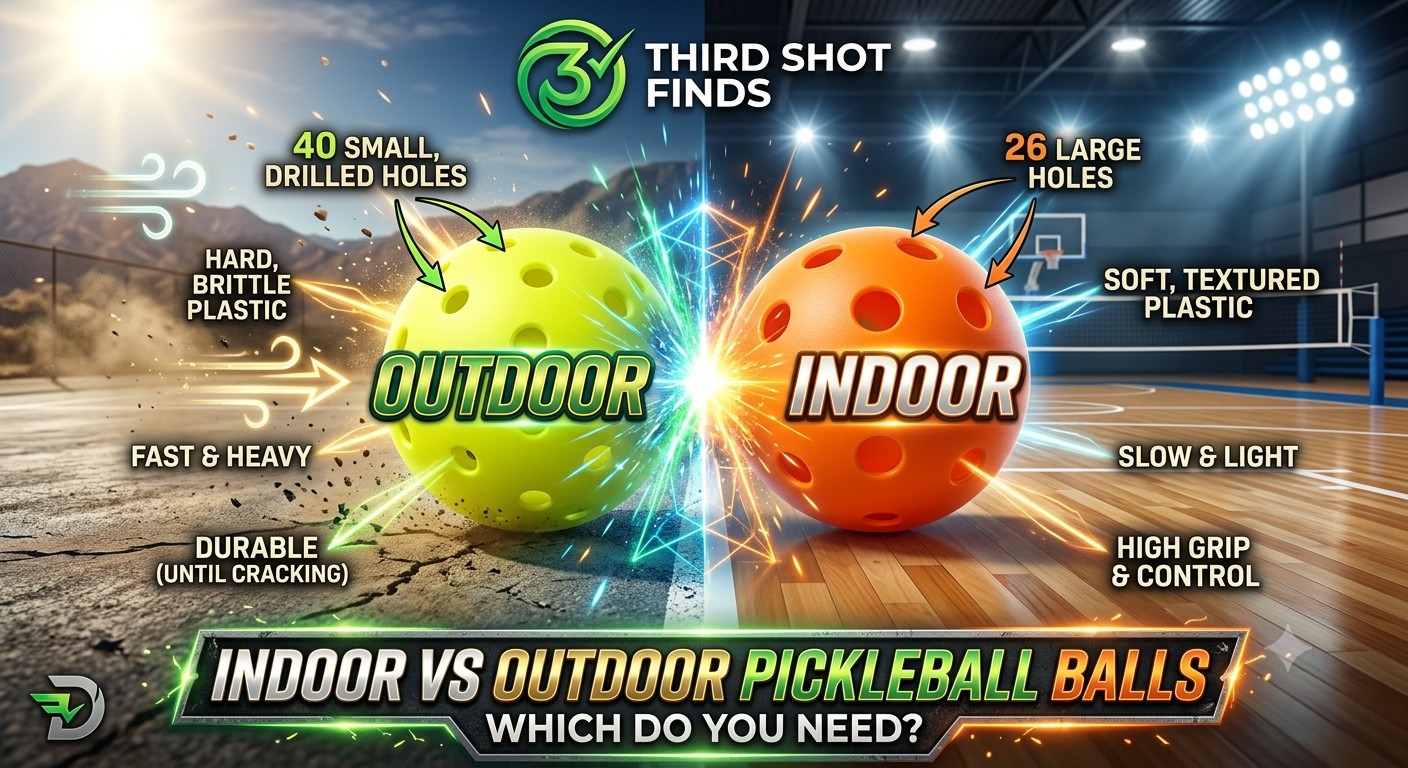
- The Specs: They have 40 small, drilled holes. They are made of a hard, thick plastic and weigh slightly more than indoor balls.
- How They Play: The 40 small holes make the ball aerodynamic, allowing it to cut right through a heavy breeze without getting pushed off course. Because the plastic is harder, they bounce higher on concrete and play much faster. When you smash an outdoor ball, it comes off the paddle like a rocket.
- The Drawback: That hard plastic has a breaking point. When the temperature drops below 50 degrees, outdoor balls become brittle and will physically crack in half during hard rallies.
- The Bestsellers: The Franklin X-40 is the undisputed king of the public parks, and the Dura Fast 40 is the traditional choice for high-level pro tournaments.
2. Indoor Pickleballs: The Gymnasium Gliders
If you are playing inside a YMCA gymnasium or a rec center with smooth, polished hardwood floors, you are playing a completely different game. There is no wind to fight, but the floor is incredibly slick.
- The Specs: They have 26 larger holes. They are made of a softer, highly textured plastic and are lighter than their outdoor counterparts.
- How They Play: The softer plastic is designed to grip the slick hardwood floor, preventing the ball from wildly skidding away every time it bounces. Because the balls are lighter and have larger holes, they float a bit more, making for longer, slower rallies with plenty of extended dink battles.
- The Drawback: If you take an indoor ball outside, the wind will grab those 26 large holes and throw your shot three courts over. Furthermore, the soft plastic will get instantly chewed up and destroyed by rough outdoor asphalt.
- The Bestsellers: The PCKL Optic Indoor and the Onix Fuse Indoor are the gold standards for gymnasium play.
3. The Driveway Dilemma: What Should I Use at Home?
If you are setting up a portable net on your driveway, you need to use an outdoor ball. Even though you are “at home,” your driveway is made of concrete or asphalt. An indoor ball will skip off the rough driveway surface unpredictably and get scratched beyond recognition in minutes. Stock up on some Franklin X-40s for your driveway games!
The Deal Dinker’s Final Take
Don’t be the player trying to serve a marshmallow in a windstorm or a bowling ball on a basketball court. If you are playing on concrete or asphalt (even if it is covered by a roof), use an outdoor ball. If you are playing on polished hardwood or a rubberized gym floor, use an indoor ball. Keep a sleeve of both in your pickleball bag, and you will always be ready for the third shot.
Frequently Asked Questions: Pickleball Types
Can I use an outdoor ball indoors?
You can, but you shouldn’t if you are on hardwood. A hard outdoor ball will slide and skid uncontrollably on a shiny gym floor instead of bouncing cleanly. It also moves too fast for tight indoor spaces. (Note: If you are playing at an indoor facility that features actual paved, hardcourt tennis surfaces, then you do use an outdoor ball!)
Why do my outdoor pickleballs keep cracking?
Because outdoor balls are made of rigid plastic, they are susceptible to “fatigue.” Repeatedly smashing the ball degrades the plastic over time until it splits. Cold weather is the biggest culprit—playing outdoors in 40-degree weather will almost guarantee cracked balls. When they lose their bounce or crack, just throw them away and grab a fresh one.
What color ball should I buy?
Optic Yellow or Neon Green are the universal standards. They provide the best contrast against blue, green, and gray courts. Avoid red, orange, or dark blue balls, as they easily blend into the background, fences, or the opponent’s clothing.