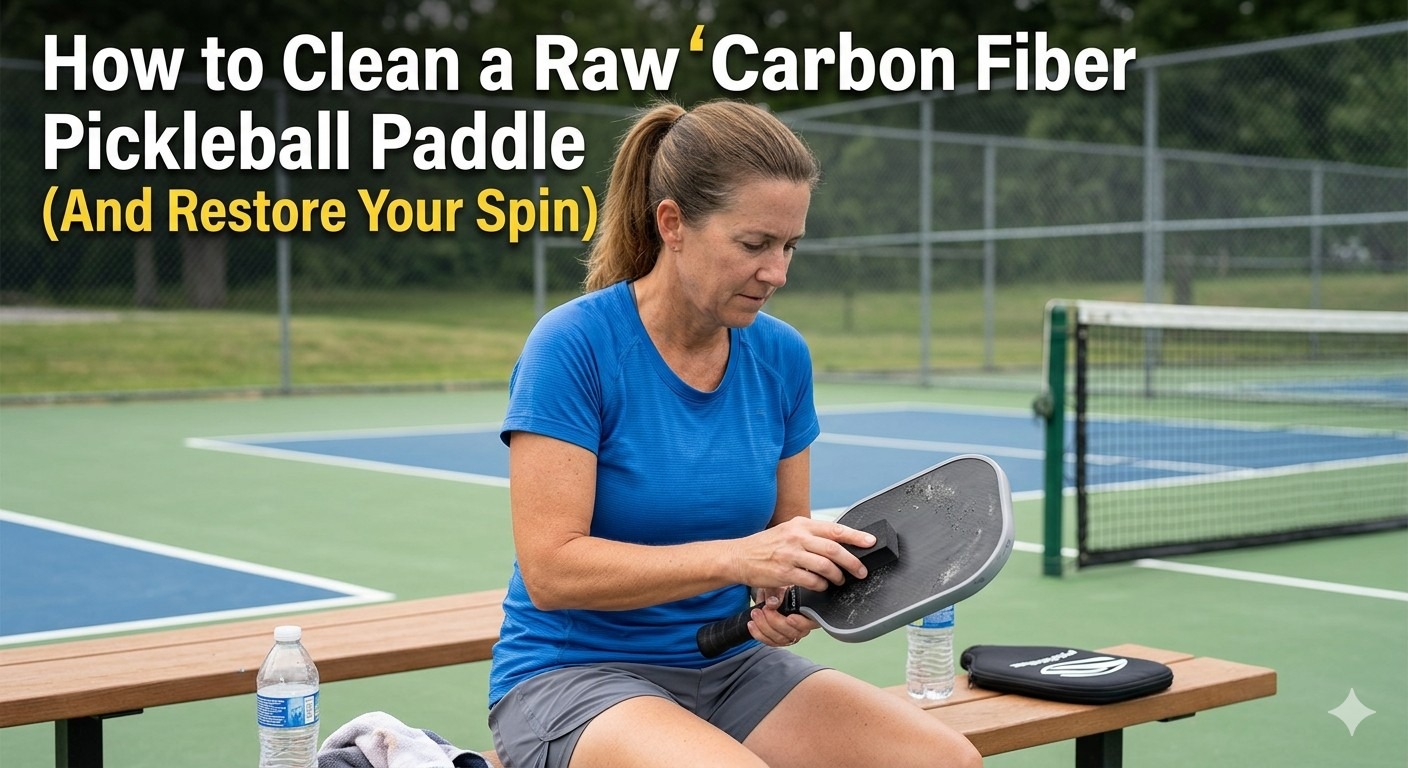
How to Clean a Raw Carbon Fiber Pickleball Paddle (And Restore Your Spin)
THIRDSHOTFINDS.COM and The Deal Dinker are reader-supported. When you buy through links on our site, we may earn an affiliate commission at no extra cost to you.
Today, we are answering one of the most frequently asked maintenance questions in the sport: how to clean a raw carbon fiber pickleball paddle. If you recently upgraded to a premium raw carbon paddle, you probably noticed how insanely gritty the face was when you first took it out of the wrapper. You were hitting heavy topspin rolls and nasty slice returns. But after a few weeks of heavy outdoor play, you might have noticed a massive drop-off in your spin. Your paddle face looks chalky, white, and surprisingly smooth. Don’t panic—your $200 paddle isn’t dead. It is just incredibly dirty. We are going to break down exactly why this happens and the $15 trick to instantly restore your paddle to factory-fresh condition. Welcome back to the kitchen line. The Deal Dinker here.
Why Does Raw Carbon Fiber Lose Its Spin?
To understand how to clean your paddle, you have to understand why it gets dirty in the first place.
Premium paddles (like the Six Zero Double Black Diamond or Vatic Pro) use Toray T700 raw carbon fiber. Instead of having a gritty texture sprayed on like cheap fiberglass paddles, the friction comes from the actual microscopic weave of the carbon fibers. It acts exactly like high-grade sandpaper.
Every time you hit a hard drive or a slicing dink, that “sandpaper” face violently grips the plastic pickleball. In the process, the carbon fiber actually shaves microscopic layers of plastic right off the ball. Over the course of dozens of matches, that white plastic dust gets deeply embedded into the weave of your paddle.
When your paddle starts looking chalky and smooth, you aren’t actually feeling worn-down carbon fiber—you are just feeling a thick layer of melted plastic dust that is filling in all the gaps. If the gaps are full of plastic, your paddle can’t grip the ball. Your spin potential plummets.
The Secret Weapon: The Carbon Fiber Paddle Eraser
You cannot clean a raw carbon fiber paddle with water, soap, or a wet rag. Getting the core of your paddle wet can cause delamination (where the face peels away from the honeycomb core), and a rag will just smear the plastic dust deeper into the weave.
To clean it properly, you need a Pickleball Paddle Eraser (also known as a cleaning block).
These blocks are made of a specialized, highly abrasive natural rubber matrix. They work exactly like a pencil eraser on paper. When you rub the block aggressively up and down the face of your paddle, the friction heats up the embedded plastic dust, and the rubber matrix grabs it and pulls it right out of the carbon weave.
Step-by-Step Cleaning Guide
Restoring your paddle takes less than 60 seconds. Here is the exact process:
- Dry the Paddle: Ensure your paddle face is completely dry. Do not attempt this if you just played in the rain or wiped it with a damp towel.
- Apply Firm Pressure: Take your rubber paddle eraser and press it firmly against the top edge of the paddle face.
- The Vertical Scrub: Rub the eraser aggressively up and down in vertical strokes, moving from the top of the paddle down to the throat. You will see white flakes and shavings start to fall off.
- The Horizontal Scrub: Once you have done the whole face vertically, switch directions. Rub the eraser horizontally from edge guard to edge guard. This ensures you are pulling plastic out of both directions of the woven carbon fiber.
- Wipe it Off: Use a dry microfiber cloth (or just your hand) to brush away the remaining rubber and plastic shavings.
Run your hand over the face of the paddle. You will be shocked. The white, chalky residue will be completely gone, and the aggressive, sandpaper-like grit will be fully restored.
Frequently Asked Questions
Can I use a paddle eraser on a fiberglass paddle?
No! Paddle erasers are designed strictly for raw carbon fiber or Kevlar-faced paddles. If you use this abrasive rubber block on a painted fiberglass or graphite paddle, you will completely strip the paint and ruin the applied grit.
How often should I clean my paddle?
For optimal spin, we recommend using a cleaning block after every two to three playing sessions. If you play in a highly dusty outdoor environment, a quick 10-second scrub after every session is even better.
Is a generic abrasive block just as good?
Yes and no. While you can technically use a generic belt-sander cleaning block from a hardware store, they are massive, heavy, and inconvenient to keep in your bag. Purpose-built pickleball erasers are perfectly sized, won’t leave weird chemical residues, and usually cost less than $15.
The Deal Dinker’s Final Verdict
Do not let your $200 paddle perform like a $30 toy just because you are skipping basic maintenance. Keeping a dedicated cleaning block in your bag is the absolute easiest, cheapest way to maintain your competitive edge and keep your spin rates at a professional level. It takes 60 seconds and instantly breathes new life into your gear.
➡️ Click Here to grab the CRBN Pickleball Paddle Eraser on Amazon and restore your spin!
Looking for other great reviews? Check out the Gear Vault!