Third Shot Tuesday: Pickleball Doubles Communication 101 [2026]
THIRDSHOTFINDS.COM and The Deal Dinker are reader-supported. When you buy through links on our site, we may earn an affiliate commission at no extra cost to you.
CLACK! We have all heard that terrible sound on the courts. A ball is hit perfectly down the center line, you and your partner both lunge for it, and your expensive carbon fiber paddles violently crash together. The ball rolls harmlessly away while you both stare at each other, uttering the classic phrase: “I thought you had it.”
In pickleball doubles, you can have the best third-shot drop in the world, but if you and your partner move like two strangers awkwardly trying to pass each other in a grocery store aisle, you will lose. Welcome back to the kitchen line. The Deal Dinker here. Today, we are mastering pickleball doubles communication.
1. The Golden Rule: “Forehand Takes the Middle”
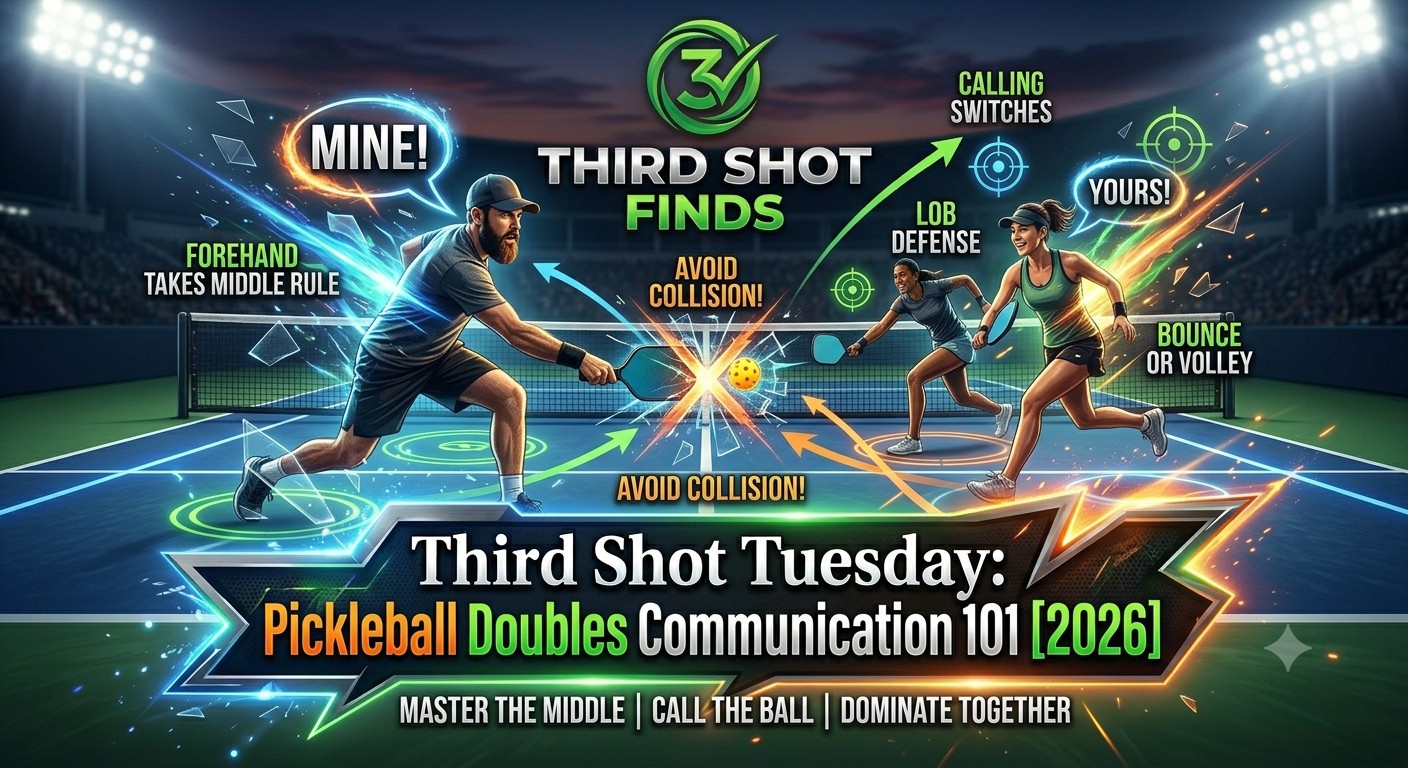
The majority of confusion happens on balls hit straight down the center line. To instantly solve this, establish the universal rule before the game even starts: The player with their forehand in the middle takes the center shots.
- Why it Wins: The forehand is anatomically stronger, has a longer reach, and offers better aggressive shot options than a backhand. If you are playing with two right-handed players, the player on the left (the odd side) has their forehand in the middle. The player on the right should naturally shade the right sideline and let their partner handle the center traffic.
2. Use Bullet Words (And Say Them Early)
When a ball is flying at you at 40 miles per hour, you do not have time for a full sentence. You need sharp, one-syllable “bullet words,” and you need to yell them the exact moment the ball leaves your opponent’s paddle.
- “MINE!” or “ME!”: Use this when you are absolutely taking the shot. Once you call it, you must commit.
- “YOURS!” or “YOU!”: Use this if the ball is out of your reach or on your partner’s dominant side.
- “NO!” or “OUT!”: Use this immediately if you see a drive flying high and heading out of bounds. This tells your partner to freeze and let the ball pass.
- “BOUNCE!”: A crucial call at the kitchen line to tell your partner to let a high dink drop rather than awkwardly trying to volley it out of the air.
3. The Art of the “Switch”
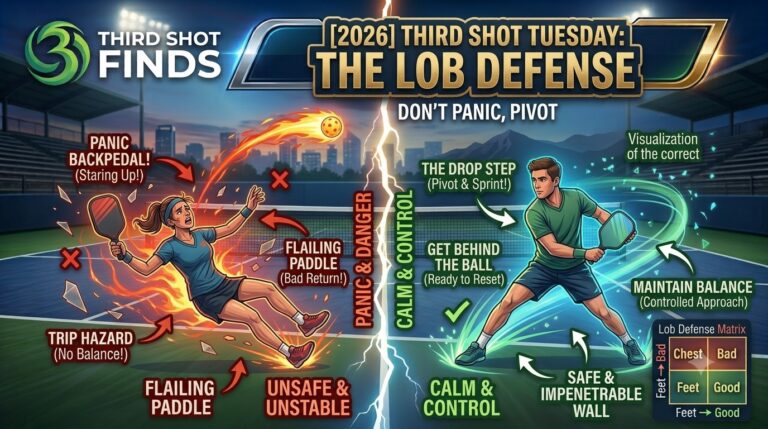
Sometimes, your opponents will hit a perfect lob over your head. If the lob goes over the left-side player’s head, that player usually has to turn and sprint backward blindly.
- The Strategy: The player on the right (who is looking diagonally and has a clear view of the ball) should yell “SWITCH!” and run diagonally back to retrieve it. The left-side player must immediately cross over to the right side of the court to cover the open space. You have successfully traded sides and kept yourselves in the point.
The Deal Dinker’s Final Take
Great doubles play is a dance. It requires setting rules before the first serve, leaving your ego at the fence, and using loud, decisive verbal cues. If you establish the “forehand in the middle” rule and practice your bullet words, you will instantly cut your unforced errors in half and stop chipping your expensive gear.
Frequently Asked Questions: Doubles Teamwork
Who makes the line calls in doubles?
The unwritten rule of pickleball is that the player looking directly down the line has the ultimate authority on the call. If your partner is closer to the ball and says it was “Out,” you trust their call immediately, even if you thought it looked “In” from a bad angle. Never argue with your partner in front of your opponents.
What is “Stacking” in pickleball?
Stacking is an advanced positioning strategy used to keep players on their preferred sides of the court for the entire game. For example, if you are right-handed and your partner is left-handed, stacking allows both of you to keep your forehands in the middle of the court 100% of the time, creating a massive offensive advantage.
How do I handle a partner who constantly steals my shots?
It requires a polite but firm conversation between rallies. Use the paddle-tap moment to say, “Hey, you have a great forehand, but I’ve got my side covered. Let’s stick to the ‘forehand takes the middle’ rule so we don’t crash.” If they keep encroaching, stand your ground, call “MINE” loudly, and assert your space.