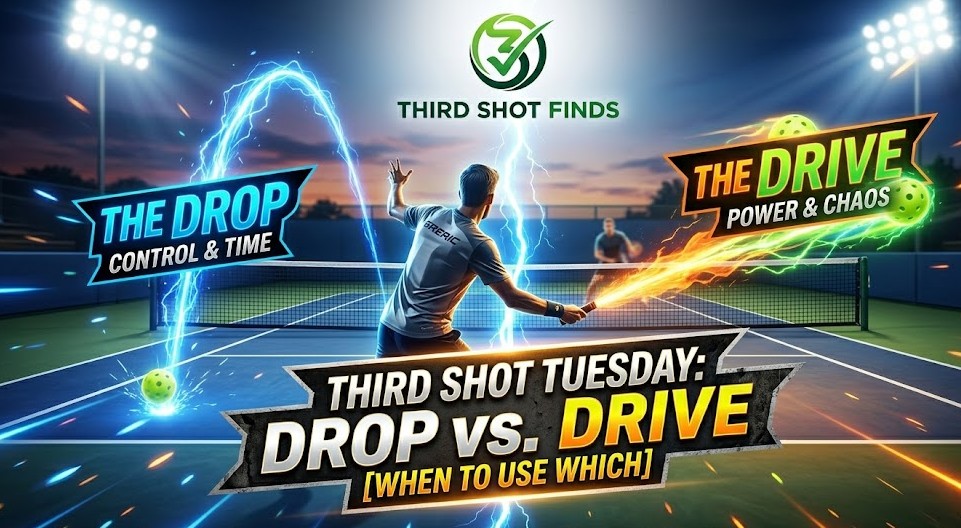
Third Shot Tuesday: Drop vs. Drive (When to Use Which in 2026)
THIRDSHOTFINDS.COM and The Deal Dinker are reader-supported. When you buy through links on our site, we may earn an affiliate commission at no extra cost to you.
Welcome back to another Third Shot Tuesday. Today, we are tackling the most debated decision in all of pickleball: Should I drop or should I drive?
If you ask a traditionalist, they will tell you the third shot drop is the only acceptable option. If you watch modern 2026 pro tours, you will see players ripping 50mph drives right at their opponents’ chests. So, who is right? The truth is, there is no universally “correct” third shot—there is only the correct shot for the specific situation you are in.
Welcome back to the kitchen line. The Deal Dinker here. Let’s break down the ultimate shot selection framework so you can stop guessing and start winning.
1. The Case for the Third Shot Drop (The Equalizer)
The third shot drop is a soft, arcing shot aimed to land squarely in your opponents’ kitchen. Its entire purpose is to buy you and your partner enough time to run from the baseline to the non-volley zone.
When to use the Drop:
- When the return is deep: If your opponent hits a great return that lands right at the baseline, you are on the defensive. Hitting a hard drive from 22 feet away gives your opponents plenty of time to react and swat it back. A drop slows the game down and neutralizes their advantage.
- When your opponents are established at the net: If both opponents are toeing the kitchen line with their paddles up, driving the ball is suicide. You are just feeding them an easy volley. Drop the ball at their feet to force them to hit up, which prevents them from attacking.
2. The Case for the Third Shot Drive (The Disrupter)
The third shot drive is a flat, hard groundstroke designed to create immediate chaos. You are not trying to win the point outright; you are trying to force a weak “pop-up” return from your opponent, setting up an easy fifth-shot drop or put-away.
When to use the Drive:
- When the return is short: If your opponent hits a weak, high-bouncing return that lands near the middle of the court (the transition zone), that is your green light. Step into the ball and unleash your forehand.
- When your opponents are caught in transition: If one of your opponents hits a return and is incredibly slow making their way to the kitchen line, drive the ball right at their feet while they are moving. It is incredibly difficult to defend a hard shot while walking forward.
3. The 2026 Meta: The Topspin Roll Drop
This year, the strategy has evolved. The best players are blending the two shots into what is called the “Topspin Roll Drop.” Instead of a flat dink or a flat drive, you drop your paddle face significantly lower and aggressively brush up the back of the ball.
This generates heavy topspin, allowing you to hit the ball with the pace of a drive, but the spin causes it to aggressively dive down into the kitchen once it crosses the net. It is the ultimate weapon to keep your opponents pinned back.
The Deal Dinker’s Final Take
Stop treating the drop and the drive like a religious debate. Read the ball. If the return is deep and heavy, soften your hands and hit a drop to buy time. If the return is short and sitting up high, punish it with a drive to force an error. Master both, and you will become entirely unpredictable.
Frequently Asked Questions: The Third Shot
Why is the third shot so important in pickleball?
Because of the “two-bounce rule,” the serving team is at a massive structural disadvantage. The returning team gets to the net first. The third shot (hit by the serving team) is the critical bridge that allows the serving team to safely transition from the baseline to the kitchen line to even the playing field.
What is the “Shake and Bake” strategy?
This is a popular offensive play in doubles utilizing the third shot drive. Player A hits a blistering third shot drive directly at an opponent. Player B (Player A’s partner) sprints to the net immediately. If the opponent struggles with the hard drive and pops the ball up into the air, Player B is already at the net waiting to “bake” (smash) the ball for a winner.
I keep hitting my third shot drops into the net. How do I fix this?
The most common mistake is having a rigid wrist and a tight grip. Loosen your grip pressure to a 3 out of 10. Imagine you are tossing a water balloon across the net. Furthermore, aim higher. Many players try to skim the net, resulting in errors. Aiming 2 to 3 feet above the net tape gives you a massive margin of error, and gravity will bring the ball down into the kitchen.