Third Shot Tuesday: How to Survive the Pickleball Transition Zone [2026]
THIRDSHOTFINDS.COM and The Deal Dinker are reader-supported. When you buy through links on our site, we may earn an affiliate commission at no extra cost to you.
It is the scariest place on the court. It is the graveyard of good rallies. It is the few feet of hardwood or concrete between the baseline and the non-volley zone, affectionately known by players as “No Man’s Land.”
If you watch 3.0 or 3.5 level pickleball, you will see players get stuck in this area constantly, frantically waving their paddles as their opponents at the kitchen line smash balls directly at their feet. Today, we are going to fix that footwork. We are going to turn No Man’s Land into your personal highway to the net. Welcome back to the kitchen line. The Deal Dinker here.
The Golden Rule: Stop Moving When They Hit
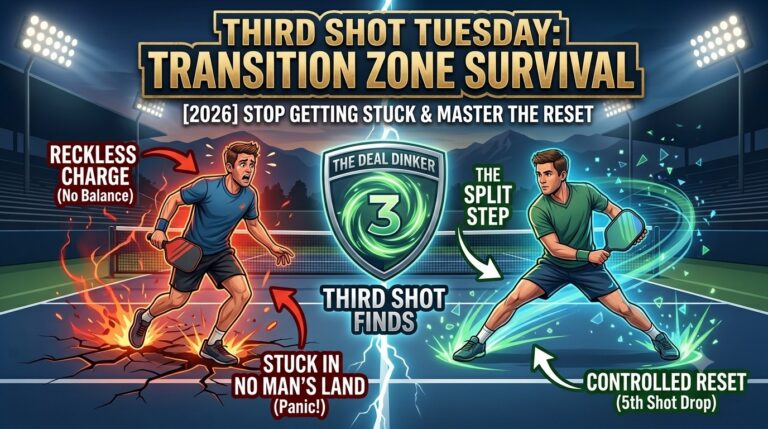
The single biggest mistake players make in the transition zone is trying to run and hit at the exact same time. When you hit your third shot drop and start moving forward, your instinct is to sprint all the way to the kitchen line in one continuous motion.
Do not do this.
If your opponent hits the ball back while you are mid-stride, your momentum will carry you forward, your paddle face will be completely unstable, and you will pop the ball up for an easy smash.
- The Fix: The moment your opponent makes contact with the ball, you must implement a “Split Step.” Stop your forward momentum, plant your feet shoulder-width apart, and get your paddle up.
The “Two-Step” Approach
You do not have to reach the kitchen line in a single sprint. In fact, against good players, you shouldn’t even try.
- Hit your drop.
- Take two explosive steps forward.
- Split step and stop.
- Hit a reset or another drop from the transition zone.
- Take two more steps forward.
By breaking the journey into two or three mini-trips, you are always balanced and ready to defend when your opponent attacks.
Paddle Position: Guard Your Shoelaces
When you are stuck in the transition zone, your opponents have the high ground at the kitchen. They are going to aim right at your feet.
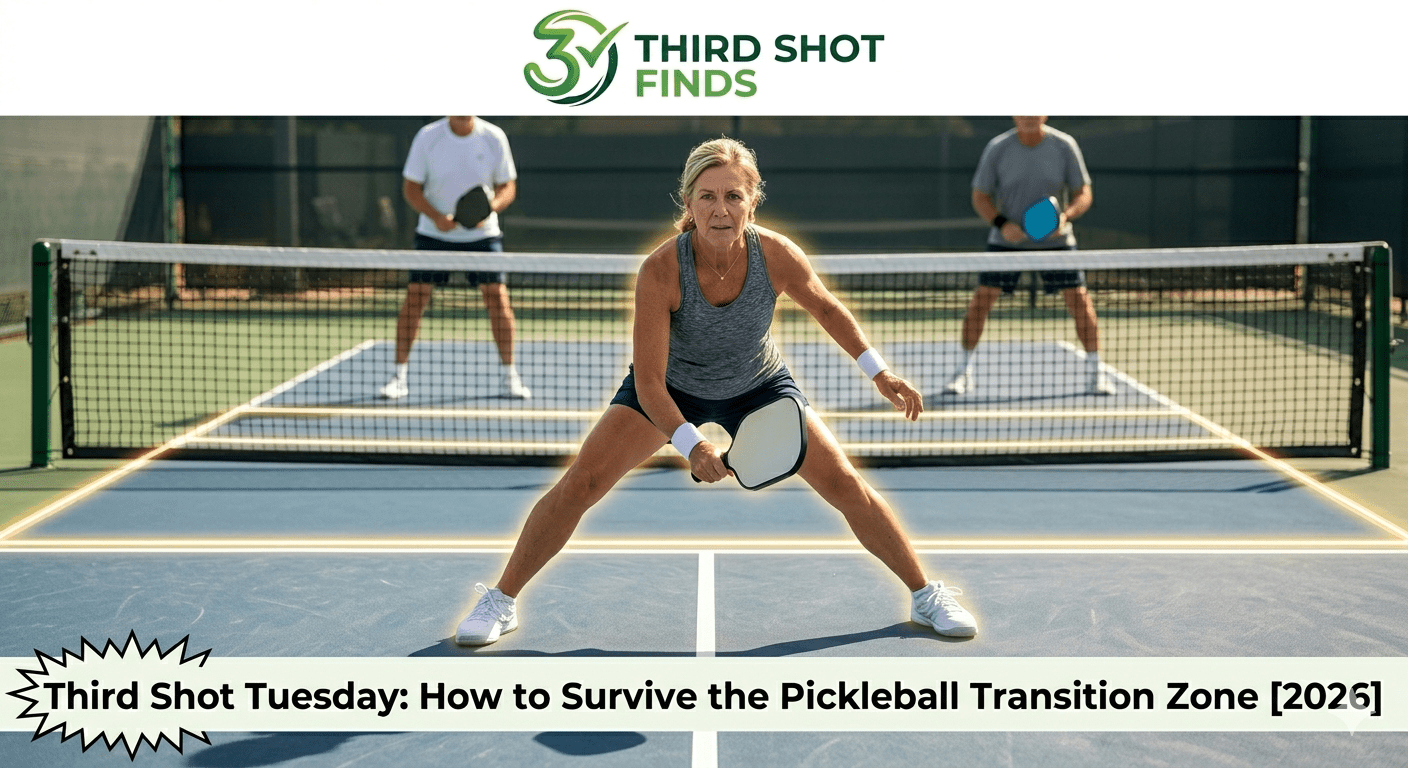
As you make your way forward, keep your paddle low and in front of your body (around knee or thigh height). You are not looking to hit aggressive drives from here; you are looking to block, absorb the pace, and softly reset the ball back into their kitchen. Think of your paddle as a shield, not a sword.
The Deal Dinker’s Final Take
Surviving the transition zone requires patience. Resist the urge to panic-sprint to the net. Hit your shot, move under control, stop completely when your opponent swings, and use your soft game to earn your spot at the kitchen line. Practice the two-step approach this week, and watch your unforced errors plummet.
Surviving the Transition Zone
What exactly is the transition zone in pickleball?
The transition zone is the physical area on the court between the baseline and the non-volley zone (the kitchen) line. It is the space you must travel through after hitting your third shot drop to reach your ultimate goal: establishing dominance at the kitchen line.
Why do players call it “No Man’s Land”?
It earned the nickname “No Man’s Land” because it is the absolute most vulnerable place to stand during a rally. If you are caught hanging out in this zone while your opponents are established at the kitchen line, they have a severe downward angle to smash the ball directly at your feet. You should only be temporarily moving through this zone, never permanently camping in it.
Should I ever hit a hard drive from the transition zone?
Rarely. When you are in the transition zone, you are usually contacting the ball from well below the top of the net. If you try to rip a high-speed drive from your shoelaces, it will almost certainly pop up high, giving your opponent an easy overhead smash. Your goal in this zone is survival and advancement—use soft drops, blocks, and resets to neutralize their attack and buy time to move forward.