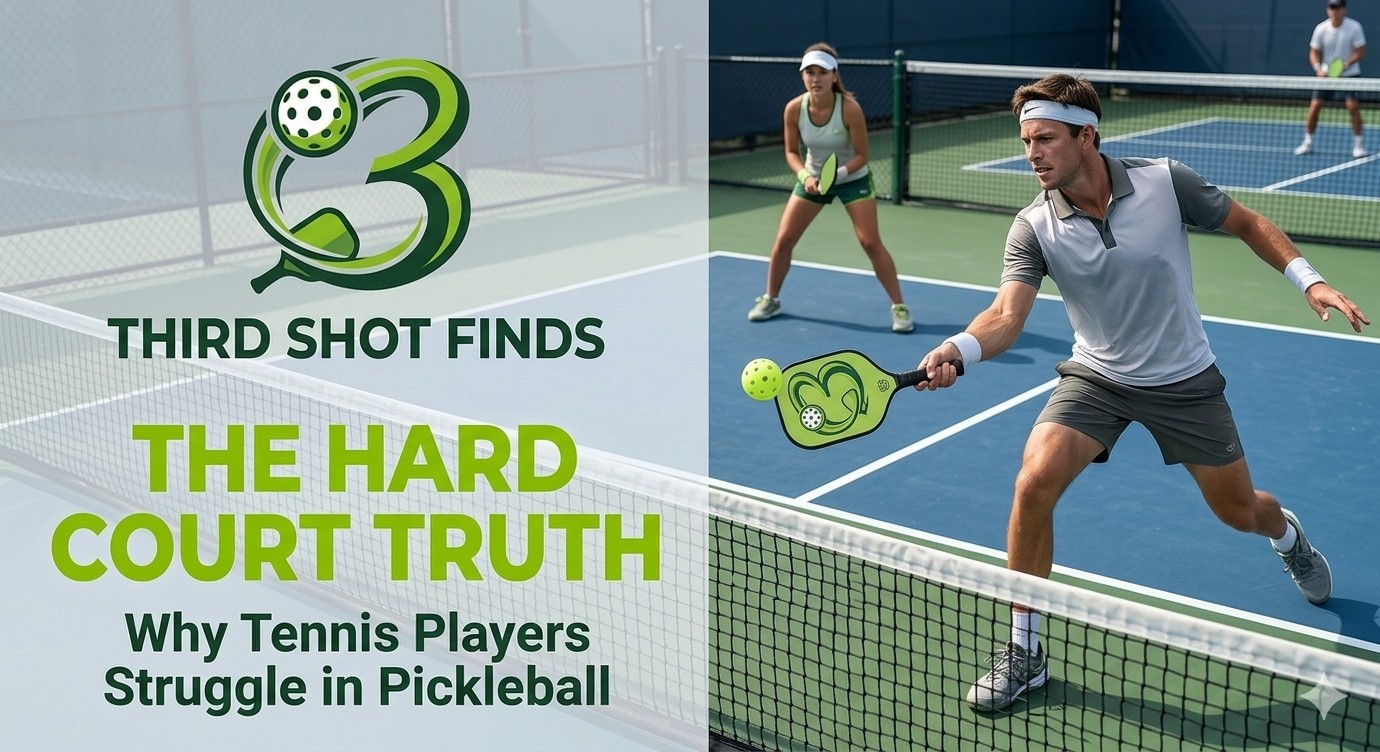
The Hard Court Truth: Why Tennis Players Struggle in Pickleball
THIRDSHOTFINDS.COM and The Deal Dinker are reader-supported. When you buy through links on our site, we may earn an affiliate commission at no extra cost to you.
It is the most common pipeline in the sport: a 4.5 or 5.0 tennis player steps onto a pickleball court for the very first time. They have elite footwork, incredible hand-eye coordination, and a baseline drive that sounds like a cannon going off. For the first few weeks, they completely dominate beginner open play using pure power.
But then, they hit a wall. As soon as they play against experienced 4.0 pickleball players, they suddenly find themselves getting dismantled. Their power is easily blocked, their volleys dump into the net, and they get called for constant foot faults.
If you are a recovering tennis player trying to figure out why your transition has stalled, you are not alone. Today, we are breaking down exactly why tennis players struggle in pickleball and the deeply ingrained habits you need to unlearn to finally break through to the next level. Welcome back to the kitchen line. The Deal Dinker here.
1. The “Big Swing” Trap
In tennis, power is generated through massive, sweeping body mechanics. You take the racquet head all the way back, load your legs, and swing through the ball.
If you take a massive backswing in pickleball, two things happen, and both of them are bad. First, because the court is so small and the players are so close together (often standing just 14 feet apart at the kitchen line), you simply do not have the time. By the time your paddle goes backward, the ball is already past you. Second, striking a wiffle ball with a huge, tennis-style groundstroke often results in a “pop-up,” feeding your opponent an easy overhead smash.
The Fix: You need to shorten your strokes. Think of your paddle as a shield rather than a baseball bat. Keep the paddle face in your peripheral vision at all times and rely on short, compact “punches” rather than full swings.
2. The Topspin Physics Problem
Tennis players love hitting heavy, dipping topspin. When they hit a tennis ball, the strings of the racquet literally “grab” the fuzzy ball, holding it in the string bed before launching it out like a trampoline. You can swing straight across the ball and the strings do the work.
Pickleball paddles do not have strings. Even the grittiest raw carbon fiber paddle cannot recreate that trampoline effect. When tennis players try to hit their signature topspin drives in pickleball using the same racquet angle, the plastic ball instantly slides off the face and dumps straight into the net.
The Fix: You have to adjust your paddle angle. To generate topspin in pickleball, your paddle face needs to be significantly more “open” (pointing slightly up toward the sky), and your swing path must be an exaggerated low-to-high brushing motion.
3. The Kitchen Volley Foot-Fault
This is the hardest habit to break. In tennis, you are taught from day one to step forward and aggressively transfer your weight into your volleys at the net.
If you do this at the pickleball kitchen line, your forward momentum will carry your foot directly onto the 7-foot Non-Volley Zone line. That is an automatic fault, and you lose the point. Ex-tennis players routinely give away free points because their brain is hardwired to step forward when they see a volley opportunity.
The Fix: Lateral movement is your best friend. Instead of stepping forward to attack, practice holding your ground right on the line and hitting your volleys from a stable, wide stance. If you must move, use lateral side-steps rather than crossing your feet.
4. The Slice Volley Default
When a tennis player gets pulled out wide or has to dig out a low ball at the net, their default emergency shot is a heavy, defensive backhand slice.
In pickleball, hitting a heavy slice from the kitchen line is a recipe for disaster. The wiffle ball reacts poorly to heavy under-spin; it tends to “float” or hang in the air for a fraction of a second too long, which is all a 4.0 pickleball player needs to step around it and smash it down your throat.
The Fix: Unlearn the slice volley. In pickleball, you need to transition to a flat push or a topspin “roll” volley. Rolling the ball with topspin keeps it dipping low below the net tape, preventing your opponents from attacking.
5. Over-Reliance on Offense
In tennis, offense is earned with more offense. You hit a harder shot, you find a better angle, and you hit a winner.
In pickleball, offense is earned through defense. Pickleball is a game of patience, positioning, and waiting for your opponent to make a mistake. Tennis players get bored dinking the ball back and forth 15 times, so they inevitably try to “speed up” a ball that is too low to attack. The result? They hit it into the net or right into the opponent’s strike zone.
The Fix: Embrace the soft game. Learn the Third Shot Drop, master the art of the unattackable dink, and realize that outlasting your opponent is just as effective as overpowering them.
The Deal Dinker’s Gear Tip for Tennis Players
If you are coming from tennis, you likely crave a paddle that has a longer handle to accommodate your two-handed backhand, as well as a stiff face that mimics the “pop” of tight tennis strings.
Stop playing with short, wide-body starter paddles. You need an elongated paddle with a 5.3-inch to 5.5-inch handle.
➡️ Click Here to check out the elongated Joola Perseus on Amazon – The ultimate weapon for ex-tennis players who need room for a two-handed backhand.