Third Shot Tuesday: Mastering the Speed-Up (Knowing When to Attack) [2026]
THIRDSHOTFINDS.COM and The Deal Dinker are reader-supported. When you buy through links on our site, we may earn an affiliate commission at no extra cost to you.
We have all been there. You are locked in a quiet, methodical cross-court dink exchange. You grow impatient, decide to pull the trigger, and accelerate through a ball near your ankles. Two seconds later, you are ducking for cover as your opponent slaps a fiery counter-attack straight down the middle.
Initiating an attack off the dink—the speed-up—is one of the most vital weapons in modern pickleball. However, a reckless speed-up is worse than a bad dink.
Welcome back to the non-volley zone for another Third Shot Tuesday. The Deal Dinker here. Today, we are breaking down the visual cues and stroke mechanics needed to turn your kitchen attacks into point-ending winners instead of self-inflicted errors.
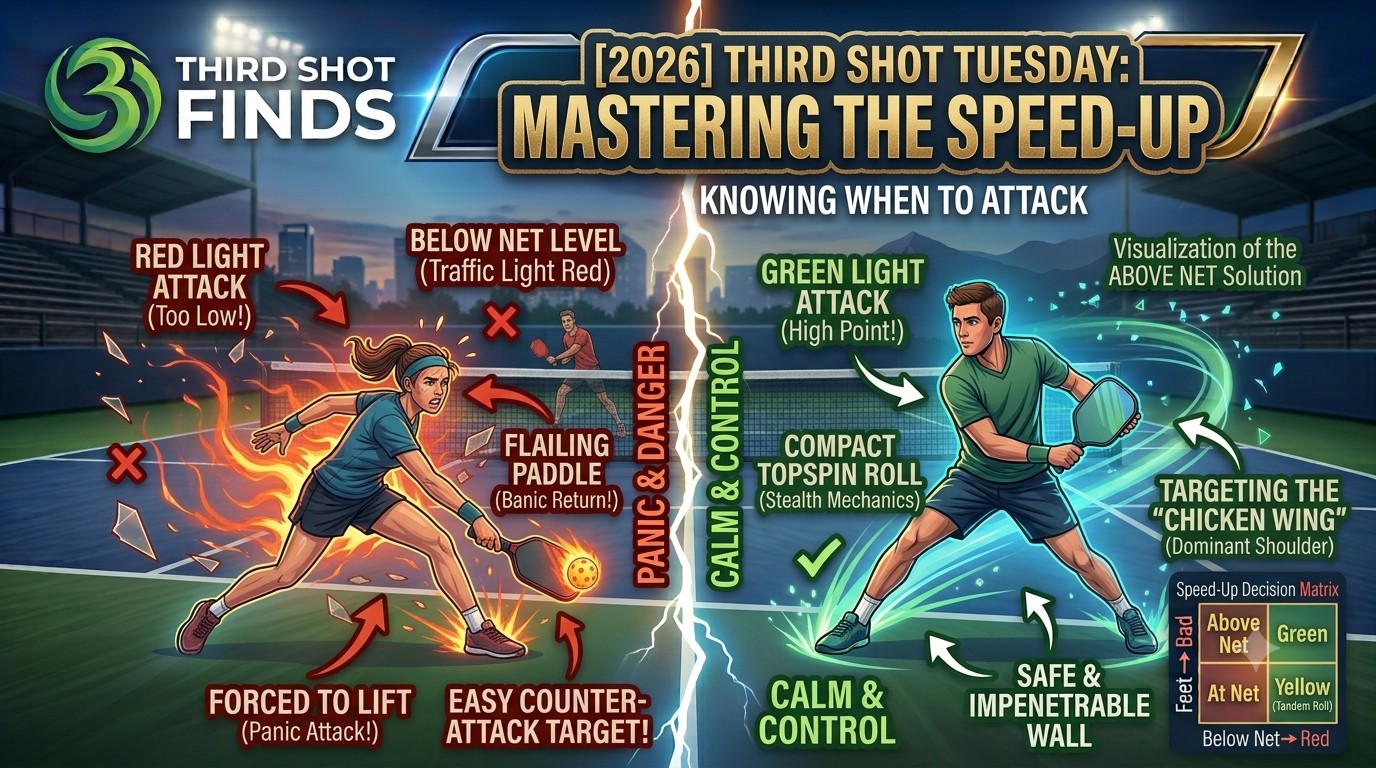
1. The Traffic Light Rule: Reading Ball Height
The single biggest factor determining whether a speed-up succeeds or fails is where you contact the ball relative to the top of the net.
- Green Light (Above Net Level): The ball has bounced high and sits at or above the net cord. You can hit downward or flat through the ball. Pull the trigger.
- Yellow Light (At Net Level): The ball is sitting right at net height. You can attack, but you must roll under the ball to generate topspin so it dips back down before reaching the opponent’s chest.
- Red Light (Below Net Level): The ball is falling toward your shins/ankles. Do not speed this up. Attacking from below net height forces you to lift the ball upward, placing it right into your opponent’s power strike zone.
2. Stealth Mechanics: The Compact Roll
If you pull your paddle way back like you are swinging a tennis racket, every alert player at the kitchen line will see your attack coming from a mile away.
- No Backswing: Hold your paddle face in front of your chest. The power from a speed-up comes from quick wrist flicking and forearm rotation, not a massive wind-up.
- Brush Up for Topspin: Start with the paddle tip slightly down and brush up the back of the ball. This gives the ball forward rotation (topspin), causing it to clear the net safely and drop sharply into your opponent’s body.
- Disguise the Setup: Keep your body posture identical to your standard dink setup until the split-second before contact.
3. Primary Target: The “Chicken Wing”
When you speed the ball up, where you aim matters just as much as how hard you hit it.
- The Dominant Shoulder/Hip: Aim directly at your opponent’s right shoulder/hip (for a right-handed player). This forces them into an awkward “chicken wing” position, stuck between choosing a forehand or backhand block.
- Off-Balance Feet: Pay attention to their stance. If an opponent is leaning heavily on one foot to reach for a dink, speed the ball up toward the space behind their weight shift.
- Avoid the Forehand Block Zone: Hitting a speed-up straight into an opponent’s paddle held comfortably out in front at waist height is asking to get countered.
The Speed-Up Decision Matrix
| Ball Height / Position | Action Required | Recommended Target |
| Above Net / Floating | Flatten out & drive downward | Opponent’s hip or center line |
| At Net Level (Push Dink) | Compact roll with heavy topspin | “Chicken wing” (dominant shoulder) |
| Below Net Level (Low Bounce) | Reset or continuation dink | Keep low at their shoelaces |
The Deal Dinker’s Final Take
A great speed-up is built on patience, not panic. The goal of dinking is not just to keep the ball in play—it is to press your opponents until they give you a ball in the “Green Zone.”
Wait for your pitch, keep your stroke compact with heavy topspin, and target the chicken wing. When executed with proper timing, your speed-up will keep your opponents on their heels all match long.