Is the $300 JOOLA Perseus Pro V Worth It? Specs & Review [2026]
THIRDSHOTFINDS.COM and The Deal Dinker are reader-supported. When you buy through links on our site, we may earn an affiliate commission at no extra cost to you.
If you have stepped onto a pickleball court in the last month, you have probably heard the whispers. Ben Johns, the undisputed #1 player in the world, just released his newest flagship weapon: the JOOLA Perseus Pro V.
Priced at a staggering $300, it is one of the most expensive stock paddles ever released. It promises revolutionary technology, massive power, and pinpoint control. But when you are standing in your driveway or at the local YMCA, do you really need a $300 paddle?
Welcome back to the kitchen line. The Deal Dinker here. Today, we are putting the JOOLA Perseus Pro V under the microscope. We are breaking down the exact specifications, explaining what the complex technology actually does for your game, and determining if you should open your wallet or look for a cheaper alternative.
1. Under the Hood: The Perseus Pro V Specifications
Pickleball manufacturers love using aggressive marketing buzzwords. Let’s strip away the marketing jargon and look at the actual physics of what makes the Pro V different.
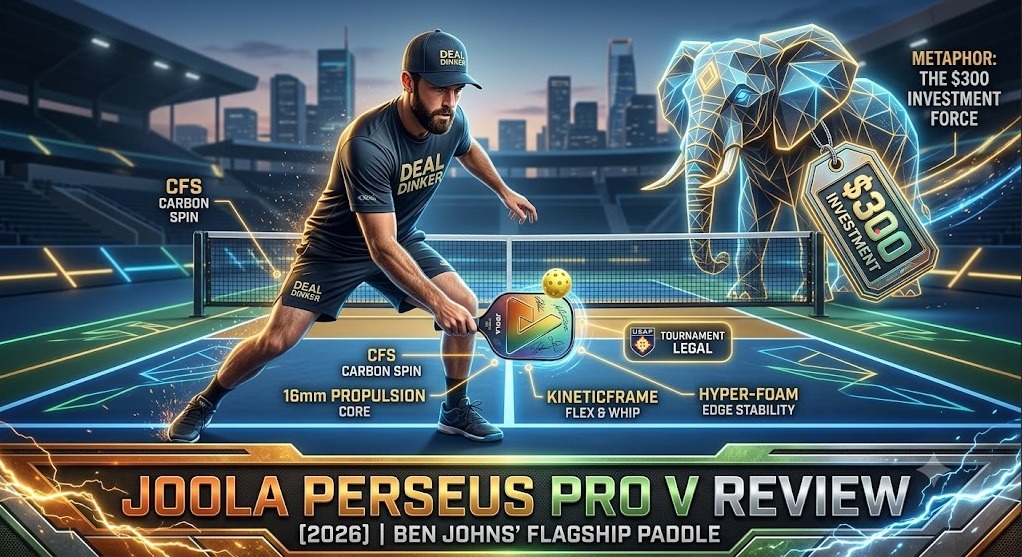
- Core Thickness: 16mm Honeycomb Propulsion Core
- Why it Matters: A 16mm core is considered “thick” in the pickleball world. Thicker cores absorb the impact of the ball, providing a massive sweet spot and incredible “dwell time” (the fraction of a second the ball stays compressed against the paddle). This allows for buttery-soft resets in the transition zone and unattackable drops. The “Propulsion” aspect means JOOLA has engineered the honeycomb to still snap back and deliver power on overhead smashes, giving you control without sacrificing offense.
- Surface: Textured Carbon Fiber (CFS)
- Why it Matters: Unlike cheap fiberglass, raw carbon fiber physically grips the plastic of the pickleball. When you brush up on the ball during a third-shot drive, the carbon texture creates massive topspin, causing the ball to violently dip over the net and stay in bounds.
- Frame: KineticFrame Technology & Hyper-Foam Edge Wall
- Why it Matters: This is the real reason the paddle costs $300. JOOLA injected specialized foam into the perimeter edge of the paddle and redesigned the throat (where the handle meets the face). This creates a “diving board” effect. When you swing hard, the throat flexes slightly, storing energy, and then snaps forward on contact. It generates effortless swing-speed whip while the foam edge stabilizes the paddle so it won’t twist in your hand if you hit it off-center.
- Shape: Elongated (16.5″ Length x 7.5″ Width)
- Why it Matters: By stretching the paddle slightly longer than standard, the Pro V gives players extra reach for digging out wide dinks and creates more leverage (power) on serves and drives.
➡️ Click Here to view the JOOLA Perseus Pro V on Amazon
2. The USA Pickleball Factor
Whenever a manufacturer pushes the boundary on power and spin technology, the immediate question is: Is it legal? In 2024 and 2025, several high-end paddles were banned from tournament play because their core technology caused the ball to fly off the face at dangerous speeds. However, the JOOLA Perseus Pro V is officially USAP Certified.
This means it has passed all independent laboratory tests for exit velocity, surface grit (spin), and deflection force. Whether you are playing a casual driveway game or entering a sanctioned 5.0 gold medal match, this paddle is entirely tournament-legal.
(For a complete breakdown of what makes a paddle legal, you can review the official equipment standards directly on the USA Pickleball Governing Site).
3. The Deal Dinker’s Verdict: Is it Worth $300?
The JOOLA Perseus Pro V is an absolute masterpiece of engineering. The KineticFrame technology genuinely delivers a unique blend of soft touch and explosive, whip-like power that older paddles simply cannot replicate.
- Who Should Buy It: If you are an advanced player (4.0 rating or higher), a tournament competitor, or someone transitioning from high-level tennis who wants the absolute best technology available, the Pro V is worth the investment. It will actively enhance your spin and finishing power.
- Who Should Skip It: If you are a beginner or a casual weekend player, do not buy this paddle. The technology will not instantly fix bad footwork or poor dinking strategy. You can get 90% of this paddle’s performance from high-quality, $100 carbon fiber alternatives (like the Vatic Pro or Friday Aura). Master the fundamentals first, then upgrade to the JOOLA when you are ready to climb the tournament brackets.
Frequently Asked Questions: JOOLA Paddles
What is the difference between 14mm and 16mm paddles?
The Perseus Pro V is offered in both thicknesses. The 16mm core is softer, providing more control, a larger sweet spot, and better shock absorption. The 14mm core is stiffer and lighter, meaning the ball pops off the face faster for quicker hand-battles at the net, but it is less forgiving on mishits.
Does Ben Johns actually use this paddle?
Yes. Unlike some celebrity endorsements, Ben Johns is deeply involved in the engineering and prototyping process with JOOLA. The Perseus Pro V 16mm is his actual paddle of choice on the professional PPA tour.
Will a carbon fiber paddle fix my pickleball elbow?
Thicker, 16mm carbon fiber paddles (like the JOOLA Perseus) absorb significantly more vibration than hard fiberglass or wooden paddles. While it cannot cure an injury, the Hyper-Foam Edge Wall actively reduces the shock traveling up your arm, making it much easier on your joints.

![Keep the Peace: The Best Quiet Pickleball Paddle for Noise Restricted Communities [2026]](https://thirdshotfinds.com/wp-content/uploads/2026/04/quiet-pickleball-paddle-768x419.jpeg)